

BLOGS
Peptide Science Explained: From Amino Acids to Modern Research
Oct
Peptide Science Explained: From Amino Acids to Modern Research
The biological landscape is governed by precise molecular messages. At the very core of this cellular communication network are peptides—short chains of amino acids that serve as biological master keys. From regulating hormone secretion and cellular repair to directing gene expression and metabolic flux, peptides influence virtually every physiological pathway in living organisms.
Whether you are a biohacker exploring cellular longevity, an athlete investigating tissue regeneration mechanisms, or a researcher analyzing metabolic signaling, establishing a solid foundation in peptide biochemistry is paramount.
This peptide science guide provides an authoritative, step-by-step breakdown of peptide architecture—tracing the journey from individual amino acids to complex synthetic research molecules and modern laboratory applications.
1. What Are Research Peptides? Defining the Molecular Scale
To understand what are research peptides, one must first understand their placement on the molecular size spectrum.
Peptides are organic polymers composed of amino acids linked together by covalent peptide (amide) bonds. While both peptides and proteins are constructed from the same amino acid building blocks, they are categorized primarily by chain length and molecular weight:
- Dipeptides & Tripeptides: 2 to 3 amino acids.
- Oligopeptides: Short chains containing between 2 and 20 amino acids.
- Polypeptides: Unbranched chains containing up to 50 amino acids (typically under $5,000\text{ Daltons}$).
- Proteins: Complex, folded macromolecular structures consisting of more than 50 amino acids, often featuring tertiary or quaternary tertiary folding patterns.
       [Amino Acid 1] + [Amino Acid 2]
                      │
                      ▼ (Condensation Reaction - H₂O Released)
             [Peptide Bond (Amide)]
                      │
                      ▼
               [Oligopeptide] (<20 AA)
                      │
                      ▼
               [Polypeptide] (<50 AA) ──► Research Peptides
                      │
                      ▼
            [Functional Protein] (>50 AA)
Because of their smaller size compared to full-sized proteins, peptides exhibit unique pharmacokinetic properties. They generally demonstrate higher target specificity than traditional small-molecule pharmaceuticals, lower immunogenicity, and the ability to interact directly with high-affinity cell surface receptors.
In experimental biology, research peptides are synthesized to mirror natural human signaling molecules or modified strategically (e.g., via esterification or pegylation) to optimize half-life, receptor binding affinity, and enzymatic resistance.
2. Fundamentals of Peptide Chemistry: The Building Blocks
The fundamentals of peptide chemistry begin with the 20 standard proteinogenic $\alpha$-amino acids. Each amino acid possesses a central alpha-carbon ($\text{C}_\alpha$) bonded to four distinct chemical functional groups:
- A basic Amino Group ($-\text{NH}_2$)
- An acidic Carboxyl Group ($-\text{COOH}$)
- A Hydrogen Atom ($-\text{H}$)
- A unique Side Chain / R-Group ($-\text{R}$)
                        H
                        │
            H₂N ─────── Cα ─────── COOH
                        │
                        R  (Unique Side Chain)
The chemical properties of the R-Group determine how the final peptide behaves in aqueous environments, how it folds in three-dimensional space, and how it binds to biological targets. Side chains are classified into four main categories:
- Non-polar / Hydrophobic: (e.g., Leucine, Isoleucine, Valine) — Drive hydrophobic core formation.
- Polar / Uncharged: (e.g., Serine, Threonine) — Form hydrogen bonds with water and receptor interfaces.
- Positively Charged / Basic: (e.g., Lysine, Arginine) — Facilitate electrostatic interactions with nucleic acids or negatively charged cell membranes.
- Negatively Charged / Acidic: (e.g., Aspartic Acid, Glutamic Acid) — Crucial for salt-bridge stabilization.

The Peptide Bond (Amide Linkage)
When two amino acids react, the carboxyl group ($-\text{COOH}$) of one amino acid reacts with the amino group ($-\text{NH}_2$) of another in a dehydration condensation reaction. This reaction eliminates a molecule of water ($\text{H}_2\text{O}$) and forms a covalent amide bond ($-\text{C}(=\text{O})-\text{NH}-$).$$\text{R}_1\text{-COOH} + \text{H}_2\text{N-R}_2 \longrightarrow \text{R}_1\text{-C}(=\text{O})\text{-NH-R}_2 + \text{H}_2\text{O}$$
This amide backbone possesses partial double-bond character due to resonance, restricting rotation around the peptide bond and creating a rigid, planar structural arrangement that stabilizes the overall peptide geometry.
3. From Amino Acid to Peptide Synthesis: How Research Peptides Are Made
Naturally occurring peptides are produced inside cells via gene transcription and ribosomal translation. However, obtaining high-purity peptides for laboratory evaluation requires chemical synthesis.
The process of amino acid to peptide synthesis was revolutionized by Robert Bruce Merrifield in 1963 through the development of Solid-Phase Peptide Synthesis (SPPS)—a discovery that earned the Nobel Prize in Chemistry.
+-------------------------------------------------------------------------+
|                  SOLID-PHASE PEPTIDE SYNTHESIS (SPPS)                   |
+-------------------------------------------------------------------------+
|                                                                         |
|  [Insoluble Resin Support]                                              |
|            │                                                            |
|            ▼                                                            |
|  1. Attach C-Terminal Amino Acid (Fmoc-Protected)                       |
|            │                                                            |
|            ▼                                                            |
|  2. Deprotection (Remove Fmoc group using Pipederine)                   |
|            │                                                            |
|            ▼                                                            |
|  3. Coupling (Add next N-Protected Amino Acid + Coupling Agent HATU/DIC)|
|            │                                                            |
|            ▼                                                            |
|  4. Wash & Repeat Cycle (C-Terminal to N-Terminal extension)            |
|            │                                                            |
|            ▼                                                            |
|  5. Cleavage & Side-Chain Deprotection (TFA Treatment)                  |
|            │                                                            |
|            ▼                                                            |
|  6. High-Performance Liquid Chromatography (HPLC) Purification (≥98%)   |
|                                                                         |
+-------------------------------------------------------------------------+
Steps in Solid-Phase Peptide Synthesis (SPPS)
- Resin Attachment: The C-terminal (carboxyl end) amino acid of the desired sequence is covalently anchored to an insoluble polymer resin bead.
- Deprotection: The $N$-terminal protecting group (typically Fmoc or Boc) is removed using a mild base, exposing a reactive free amino group.
- Coupling: The next amino acid, activated by a coupling reagent (such as HATU or DIC/Oxyma), is introduced. It forms a new peptide bond with the exposed $N$-terminus.
- Iterative Cycle: Steps 2 and 3 are repeated sequentially, building the peptide chain from the C-terminus to the N-terminus.
- Cleavage & Deprotection: Once the full sequence is assembled, harsh acid (such as Trifluoroacetic Acid / TFA) cleaves the peptide from the resin and removes side-chain protecting groups.
- Purification: The crude peptide is purified via Reverse-Phase High-Performance Liquid Chromatography (RP-HPLC) to remove truncated sequences or side products.
For high-precision scientific trials, analytical purity must meet strict thresholds ($\ge 98\%$). Researchers can inspect batch purity through verifiable test documentation on our Certificate of Analysis library.
4. How Peptides Work in the Body: Mechanisms of Action
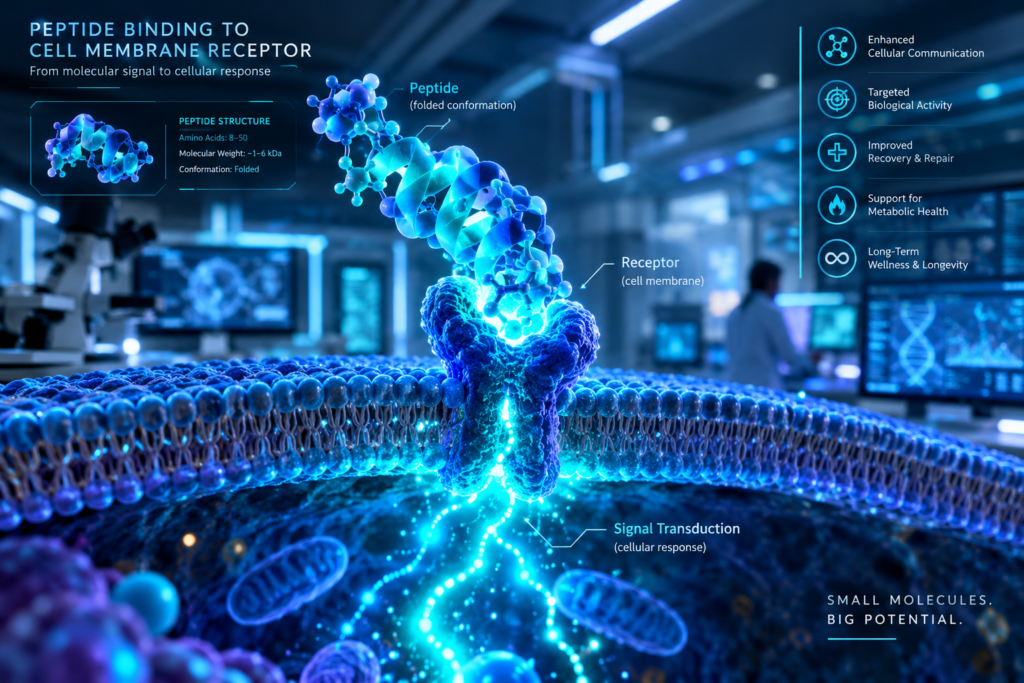
Understanding how peptides work in body systems requires examining cell surface interactions. Because peptides are hydrophilic and relatively large compared to steroid hormones, most cannot freely pass through lipid cell membranes. Instead, they operate as extracellular primary messengers.
       [Extracellular Space]
           Peptide Ligand
                 │
                 ▼
     ┌───────────────────────┐
     │  G-Protein Coupled    │  <-- Cell Membrane
     │    Receptor (GPCR)    │
     └───────────┬───────────┘
                 │
  ───────────────┼──────────────── [Cell Membrane]
                 │
        [Intracellular Space]
                 ▼
      G-Protein Activation (Gαs / Gαq)
                 │
                 ▼
  Second Messenger Cascade (cAMP / IP₃ / Ca²⁺)
                 │
                 ▼
  Downstream Protein Kinases (PKA / Akt / MAPK)
                 │
                 ▼
   Target Gene Transcription & Physiological Response
1. Receptor Activation & High Affinity
Peptides bind to specific membrane-bound receptors—most commonly G-Protein Coupled Receptors (GPCRs) or Receptor Tyrosine Kinases (RTKs). The steric shape and charge distribution of the peptide fit into the receptor’s binding pocket like a key into a lock.
2. Signal Transduction & Second Messengers
Upon ligand binding, the receptor undergoes a conformational change. This change activates intracellular signaling cascades involving second messengers such as cyclic adenosine monophosphate ($\text{cAMP}$), inositol trisphosphate ($\text{IP}_3$), or calcium ions ($\text{Ca}^{2+}$).
3. Downstream Cellular Cascades
These intracellular signals activate specific enzymes (like Protein Kinase A or Akt) that alter metabolic states, stimulate cellular repair pathways, trigger growth hormone release, or upregulate collagen gene transcription.
4. Enzymatic Degradation & Half-Life
Natural peptides are rapidly degraded by endogenous peptidases and proteases in the bloodstream. This rapid clearance creates a short biological half-life, preventing over-stimulation. Synthetic research peptides often incorporate subtle chemical structural modifications—such as D-amino acid substitution, acetylation, or fatty acid conjugation—to extend their active systemic duration.
5. Major Research Domains & Peptide Categories
Peptide science spans multiple distinct disciplines within physiological and cellular literature:
| Research Domain | Key Exemplar Peptides | Primary Focus Pathways |
| Tissue Repair & Orthopedics | BPC-157, TB-500 | Angiogenesis, tendon collagen synthesis, mucosal repair |
| Endocrine & Growth Factor | CJC-1295, Ipamorelin, Sermorelin | Pituitary GH secretagogue pathways, IGF-1 regulation |
| Metabolic Health & Weight | Semaglutide, Tirzepatide, GLP-3RT | Incretin signaling, glucose regulation, lipid turnover |
| Skin Reconstruction & Anti-Aging | GHK-Cu, Epithalon | Matrix metalloproteinase regulation, telomerase, collagen |
| Cognitive & Nootropic | Semax, Selank | BDNF upregulation, neuroprotection, GABAergic signaling |
To learn more about our quality control frameworks and laboratory standards, visit our About Us page.
6. Common Misconceptions vs. Scientific Realities
┌──────────────────────────────────────────────┬──────────────────────────────────────────────┐
│                MISCONCEPTION                 │              SCIENTIFIC REALITY              │
├──────────────────────────────────────────────┼──────────────────────────────────────────────┤
│ "Peptides are the same as anabolic steroids." │ Peptides are amino acid chains acting via   │
│                                              │ GPCRs; steroids are lipophilic cholesterol   │
│                                              │ derivatives acting on nuclear receptors.     │
├──────────────────────────────────────────────┼──────────────────────────────────────────────┤
│ "All peptides can be taken orally."         │ Stomach acids and digestive enzymes (pepsin, │
│                                              │ trypsin) rapidly breakdown standard peptide  │
│                                              │ bonds into basic amino acids.                │
├──────────────────────────────────────────────┼──────────────────────────────────────────────┤
│ "Higher purity percentages don't matter."    │ Impurities in sub-90% batches can trigger    │
│                                              │ off-target biological responses or immune    │
│                                              │ sensitization in experimental models.        │
└──────────────────────────────────────────────┴──────────────────────────────────────────────┘
7. Handling, Reconstitution, & Storage Best Practices
Maintaining structural stability is crucial when conducting research with reconstituted lyophilized powders:
- Lyophilized Powder Storage: Store unopened, dry research vials in a temperature-controlled freezer at $-20^\circ\text{C}$ ($-4^\circ\text{F}$) protected from ambient light.
- Reconstitution Technique: Reconstitute using sterile Bacteriostatic Water ($0.9\%$ benzyl alcohol). Direct the stream along the glass container wall to prevent mechanical shearing of peptide chains.
- Avoid Agitation: Never shake a reconstituted peptide vial vigorously; gently rotate or swirl to dissolve the solute completely.
- Post-Reconstitution Care: Store liquid solutions refrigerated at $2^\circ\text{C}$ to $8^\circ\text{C}$ ($36^\circ\text{F}$ to $46^\circ\text{F}$) and use within specified stability windows.
For details regarding shipping conditions, transit times, and replacement policies, please review our official Payment and Refund Policy.
Frequently Asked Questions (FAQs)
What is the difference between a synthetic peptide and a natural peptide?
Chemically, synthetic peptides and natural peptides are identical in sequence. However, synthetic peptides are manufactured in controlled laboratory environments via Solid-Phase Peptide Synthesis (SPPS), ensuring zero biological contamination (e.g., from viruses or cellular debris) and allowing for custom structural modifications.
Why do research peptides require lyophilization (freeze-drying)?
Peptides in aqueous liquid solutions are vulnerable to hydrolytic degradation and cleavage over time. Lyophilization removes water content under vacuum conditions, locking the peptide into a stable crystalline structure that extends shelf-life during storage and transit.
How do I confirm the purity and sequence identity of a peptide?
Purity and identity are confirmed using two analytical tools: High-Performance Liquid Chromatography (HPLC), which measures compound purity percentage, and Mass Spectrometry (MS), which verifies exact molecular mass.
Conclusion & Next Steps
Peptide chemistry represents one of the most promising frontiers in modern molecular biology. By translating the basic language of amino acids into tailored cellular signals, peptide science offers unprecedented tools for investigating metabolic control, cellular repair, and endocrine regulation.
Whether you are designing advanced in vitro assays or sourcing high-purity reference materials for ongoing research, partnering with a supplier that prioritizes analytical validation is essential.
Explore our batch testing reports directly via our Certificate of Analysis library, or explore our full supply catalog at PEPTIDES GREY MARKET. Have questions regarding specialized research compounds? Reach out directly through our Contact Us portal to speak with an expert support specialist.
