

BLOGS
Body Enhancement Compounds Explained: Peptides, SARMs & Steroids.
Oct
High-purity research peptides and body enhancement compounds provide laboratory professionals and biomedical researchers with precise biochemical tools for studying cellular repair, metabolic pathways, and tissue regeneration. Formulated to meet rigorous quality standards, these research-grade formulations support consistent, reproducible experimental outcomes in muscular hypertrophy, growth hormone axis modulation, and tissue repair studies. Every batch undergoes comprehensive quality control testing to verify compound identity, purity, and concentration. Before placing an order for research materials, review our verified Certificate of Analysis reports to inspect analytical testing data, or visit our central Shop to explore our complete catalog of research-grade peptides. Learn more about our commitment to scientific compliance by visiting our About Us page, or review our clear Shipping policy and Payment and refund policy before finalizing orders. Dedicated customer support is always accessible through our Contact Us portal for technical and order inquiries, ensuring a seamless, transparent laboratory supply procurement service experience.
The search for physical optimization, accelerated cellular recovery, and enhanced muscular development has driven significant scientific interest in body enhancement compounds. Modern sports pharmacology and endocrinology encompass a vast spectrum of agents ranging from endogenous signaling peptides and tissue-selective receptor modulators to potent synthetic anabolic-androgenic steroids (AAS). Understanding the fundamental biochemical mechanisms, therapeutic potentials, and safety profiles of these diverse drug classes is essential for researchers, healthcare professionals, and informed athletes alike.
Whether investigating muscle hypertrophy pathways in a laboratory setting or analyzing physiological responses to anabolic agents, performing an evidence-based anabolic compounds comparison reveals stark differences in how these substances interact with human biology. This article breaks down the three primary categories of performance and tissue-enhancement agents: muscle building peptides, bodybuilding SARMs, and classic anabolic steroids.
Understanding the Landscape of Body Enhancement Compounds
The overarching category of body enhancement compounds includes any agent designed to alter protein synthesis, nitrogen retention, growth hormone dynamics, or metabolic efficiency to favor lean tissue accumulation and recovery. However, grouping all performance-enhancing agents together overlooks their vastly distinct physiological targets and risk profiles.
To analyze these compounds systematically, researchers generally divide them based on their primary biological pathways:
- Upstream Signaling Modulators (Peptides): Molecules that mimic natural signaling cascades to stimulate biological processes like endogenous growth hormone secretion.
- Selective Receptor Agonists (SARMs): Synthetic ligands engineered to bind specific nuclear receptors in target tissues while sparing non-target organs.
- Direct Gene Translocators (Anabolic Steroids): Synthetic derivatives of androgenic hormones that bind systemically to androgen receptors, directly modifying gene transcription across all organ systems.
By examining each class through a molecular and clinical lens, we can appreciate why scientific interest has shifted toward targeted, tissue-selective modalities.
Class 1: Muscle Building Peptides & Growth Hormone Secretagogues
Peptides are short chains of amino acids linked by peptide bonds, typically ranging from 2 to 50 amino acid residues in length. In physiological terms, peptides function as primary cellular messengers, endocrine hormones, or neurotransmitters. In the context of tissue building and physical recovery, muscle building peptides primarily target the somatotropic axis—the endocrine system responsible for regulating growth hormone (GH) and insulin-like growth factor 1 (IGF-1).
Mechanism of Action
Unlike synthetic hormones introduced externally, peptide secretagogues operate upstream. They bind to specific membrane receptors on pituitary cells (somatotropes) to stimulate the pulsatile secretion of natural human growth hormone ($hGH$).
- GHRH Analogues (e.g., CJC-1295, Sermorelin): Mimic endogenous Growth Hormone-Releasing Hormone by binding to the GHRH receptor, promoting steady GH production.
- GHRPs / Ghrelin Agonists (e.g., Ipamorelin, GHRP-6): Bind to the Growth Hormone Secretagogue Receptor (GHSR) to trigger distinct, pulsatile releases of GH without drastically altering prolactin or cortisol levels.
According to research indexed by the National Center for Biotechnology Information (NCBI), stimulating endogenous GH release supports satellite cell activation, collagen synthesis, and lipid oxidation while preserving normal physiological feedback loops.
Primary Benefits and Clinical Focus
- Connective Tissue Support: Enhances collagen synthesis in tendons, ligaments, and skeletal muscle matrix.
- Metabolic Rate Regulation: Promotes lipolysis (fat breakdown) through GH-mediated enzymatic pathways.
- Preservation of the HPTA: Peptide secretagogues do not suppress the hypothalamic-pituitary-testicular axis (HPTA), meaning natural testosterone production remains intact.
To explore available research-grade secretagogues and cellular repair peptides, visit our primary Shop or read more about quality standards on our homepage.
Class 2: Bodybuilding SARMs (Selective Androgen Receptor Modulators)
Selective Androgen Receptor Modulators, commonly known as bodybuilding SARMs, represent a significant technological attempt to separate the beneficial anabolic effects of androgenic agents from their unwanted androgenic side effects.
Tissue Selectivity Explained
Traditional anabolic steroids activate androgen receptors throughout the entire body—including skeletal muscle, bone tissue, prostate gland, hair follicles, and the central nervous system. In contrast, SARMs (such as LGD-4033, RAD-140, and MK-2866) are non-steroidal ligands engineered to act as partial or full agonists in muscle and bone cells while exhibiting minimal activity in prostate and epidermal tissues.
The primary mechanism behind this tissue selectivity involves unique conformational changes in the androgen receptor upon ligand binding, combined with tissue-specific co-activator and co-repressor protein expression.
                    ┌───────────────────────────────────────────┐
                    │      TARGETED RECEPTOR INTERACTION       │
                    └─────────────────────┬─────────────────────┘
                                          │
                  ┌───────────────────────┴───────────────────────┐
                  ▼                                               ▼
     ┌─────────────────────────┐                     ┌─────────────────────────┐
     │  SKELETAL MUSCLE & BONE │                     │  PROSTATE & EPIDERMIS   │
     ├─────────────────────────┤                     ├─────────────────────────┤
     │ • High Co-Activator     │                     │ • Low Co-Activator      │
     │   Recruitment           │                     │   Recruitment           │
     │ • Direct Anabolic Signal│                     │ • Minimal AR Activation │
     └────────────┬────────────┘                     └────────────┬────────────┘
                  │                                               │
                  ▼                                               ▼
       Accelerated Hypertrophy                         Reduced Off-Target
       & Increased Bone Density                           Side Effects
Safety and Endocrinological Considerations
While SARMs present a lower androgenic risk profile compared to classic steroids, they are not completely devoid of systemic impact. Clinical evaluations published in peer-reviewed journals such as the Journal of the American Medical Association (JAMA) indicate that higher dosages of SARMs can lead to dose-dependent suppression of total testosterone and HDL cholesterol alterations. Consequently, post-cycle endocrine monitoring remains a critical standard in SARMs clinical protocols.
Class 3: Anabolic-Androgenic Steroids (AAS)
Anabolic-Androgenic Steroids represent synthetic derivatives of the primary male sex hormone, testosterone. Developed originally in the early-to-mid 20th century for clinical conditions such as hypogonadism, muscle-wasting diseases, and severe anemia, AAS represent the most potent anabolic agents known in sports science.
Direct Anabolic Mechanism
Steroids operate by passively diffusing across cellular membranes and binding directly to cytosolic androgen receptors. The ligand-receptor complex translocates into the cell nucleus, binding to specific androgen response elements (AREs) on DNA. This directly upregulates transcription factors that increase protein synthesis and nitrogen retention while suppressing catabolic glucocorticoid activity.
Endocrinological Risks and Side Effects
While AAS generate unmatched muscular hypertrophy and force production, their systemic binding leads to significant clinical risks:
- HPTA Shutdown: Exogenous androgen administration completely suppresses luteinizing hormone (LH) and follicle-stimulating hormone (FSH), leading to testicular atrophy and endogenous testosterone cessation.
- Cardiovascular Strain: AAS alter lipid balances by lowering high-density lipoprotein (HDL) and elevating low-density lipoprotein (LDL), while increasing left ventricular wall thickness and blood pressure.
- Hepatotoxicity: C17-alpha alkylated oral steroids place severe metabolic strain on liver cells, elevating transaminase enzymes and risking hepatic distress.
Detailed Anabolic Compounds Comparison
To better contrast these three classes of muscle growth compounds, the table below outlines their molecular targets, potency levels, endocrinological impacts, and typical safety parameters.
| Parameter | Muscle Building Peptides | Bodybuilding SARMs | Anabolic Steroids |
| Primary Target | Pituitary GHRH / GHSR Receptors | Selective Muscle/Bone Androgen Receptors | Systemic Androgen Receptors |
| Anabolic Potency | Moderate (Sustained lean mass & recovery) | Moderate to High (Rapid mass & strength gains) | Extreme (Maximum protein synthesis rate) |
| HPTA Suppression | None ($0\%$ suppression of natural testosterone) | Mild to Moderate (Dose-dependent suppression) | Complete ($100\%$ HPTA suppression) |
| Cardiovascular Risk | Very Low | Low to Moderate (Lipid alterations) | High (Elevated BP, HDL depletion) |
| Hepatotoxicity | None | Low to Moderate (Compound specific) | High (Particularly oral derivatives) |
| Administration | Subcutaneous Injection | Oral Solution / Capsule | Intramuscular Injection / Oral |
| Regulatory Status | Laboratory Research Compounds | Investigational Research Drugs | Controlled Substances (Schedule III in USA) |
Research Standards, Quality Verification, and Compliance
When conducting research involving advanced biomedical agents or body enhancement compounds, analytical transparency is essential. Synthetic purity directly dictates experimental consistency and safety. Impurities, heavy metals, or degraded peptide chains can completely distort clinical trial data or research outcomes.
Researchers purchasing laboratory materials should always demand verifiable independent testing. At Peptides Grey Market, we maintain strict quality control standards across our entire catalog. Every batch is subjected to High-Performance Liquid Chromatography (HPLC) and Mass Spectrometry (MS) analysis. You can review batch-specific analytical testing at any time via our official Certificate of Analysis page.
To review our operational policies, ordering procedures, and regulatory commitments, please consult our dedicated informational resources:
- Learn more about our mission on our About Us page.
- Review order processing times and logistics under our Shipping policy.
- Understand buyer protections via our Payment and refund policy.
- Inspect data protection practices through our Privacy Policy.
- Reach our support staff directly via our Contact Us page.
Conclusion
The evolution of performance pharmacology highlights a continuous effort toward greater biochemical precision. While anabolic steroids remain the standard for pure anabolic magnitude, their severe endocrine shutdown and cardiovascular risks limit their long-term therapeutic safety. SARMs offer targeted tissue selectivity, though they still carry mild endocrine suppression. Meanwhile, muscle building peptides offer a highly targeted biological approach—stimulating natural physiological growth cascades without disrupting natural hormone production.
Understanding these distinctions allows researchers, medical professionals, and fitness enthusiasts to evaluate muscle growth compounds with scientific rigor. As biotechnology continues to advance, tissue-specific target modalities will remain at the forefront of human optimization and physiological research.
Frequently Asked Questions (FAQ)
1. What are body enhancement compounds?
Body enhancement compounds are biologically active agents—including peptides, SARMs, and anabolic steroids—designed to influence protein synthesis, tissue repair, growth hormone release, or body composition.
2. How do muscle building peptides differ from anabolic steroids?
Muscle building peptides work upstream by signaling the pituitary gland to release natural growth hormone, preserving endogenous testosterone systems. Anabolic steroids directly enter cells and bind androgen receptors systemically, causing complete endogenous testosterone shutdown.
3. Do SARMs shut down natural testosterone production?
SARMs do not cause immediate complete HPTA shutdown like steroids, but higher doses or extended research cycles can cause dose-dependent suppression of luteinizing hormone and natural testosterone levels.
4. Which category of compounds is safest for tissue recovery?
Research peptides (such as growth hormone secretagogues and collagen-synthesizing signaling sequences) generally present the lowest systemic risk profile because they work within natural biological signaling feedback pathways.
5. Why is high-performance liquid chromatography (HPLC) testing important for peptides?
HPLC testing verifies compound purity and concentration, ensuring that research materials are free from chemical contaminants, residual solvents, or degraded sequence fragments.
6. Where can I inspect analytical purity reports for research compounds?
You can inspect batch-specific laboratory testing results on our dedicated Certificate of Analysis page.
Body Enhancement Compounds Explained: Peptides, SARMs & Steroids
The field of sports pharmacology, endocrinology, and performance research has expanded rapidly over the last two decades. While traditional anabolic research focused primarily on synthetic testosterone derivatives, contemporary scientific investigation spans diverse biological classes, including Selective Androgen Receptor Modulators (SARMs) and short-chain amino acid sequences known as peptides.
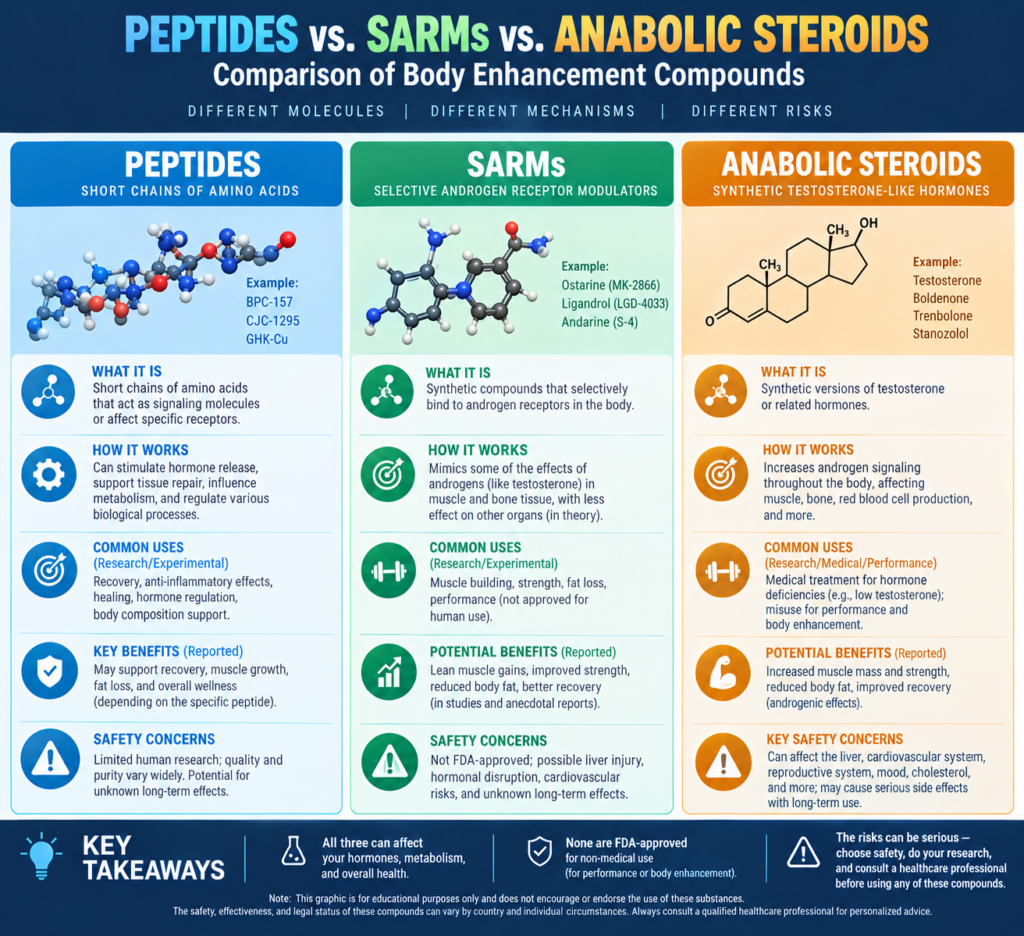
For researchers, strength-training enthusiasts, and life-science readers evaluating peptides vs sarms vs steroids, understanding the fundamental differences in chemical structure, physiological pathways, and side-effect profiles is essential. Although these three categories are frequently grouped under the umbrella of body-enhancement compounds, they operate through completely distinct biological mechanisms.
This comprehensive guide breaks down how steroids, SARMs, and peptides function at the cellular level, compares their effectiveness for hypertrophy and recovery, and evaluates their safety profiles based on current scientific literature.
Anabolic-Androgenic Steroids (AAS): The Traditional Foundation
Anabolic-Androgenic Steroids (AAS) represent the oldest and most extensively documented class of performance-enhancing agents. Derived synthetically from endogenous male sex hormones—primarily testosterone—steroids are designed to enhance protein synthesis and promote androgenic physical characteristics.
How Steroids Work in the Body
Steroids function through direct, systemic androgen receptor activation. Once introduced into the bloodstream, steroid molecules cross cell membranes and bind directly to androgen receptors located throughout skeletal muscle tissue, bone cells, hair follicles, and internal organs.
Upon binding, the hormone-receptor complex translocates into the cell nucleus, where it alters gene expression to directly increase muscle protein synthesis (MPS) and nitrogen retention. This direct pathway produces pronounced anabolic effects, promoting rapid gains in muscle mass, force production, and skeletal tissue density.
Physiological Trade-offs and Health Risks
Because androgen receptors exist throughout the human body—not just in skeletal muscle—systemic steroid use activates receptors in non-target tissues. This lack of tissue selectivity accounts for the well-documented side effects associated with anabolic steroids:
- Hypothalamic-Pituitary-Gonadal (HPG) Axis Suppression: Exogenous androgen intake signals the brain to suspend natural testosterone production, leading to testicular atrophy and hormonal dependence.
- Cardiovascular Strain: Anabolic steroids often alter lipid profiles by suppressing High-Density Lipoprotein (HDL) cholesterol while increasing Low-Density Lipoprotein (LDL), elevating cardiovascular risk factors according to clinical studies archived at the National Institutes of Health (NIH).
- Androgenic Side Effects: Systemic receptor binding can lead to accelerated male-pattern hair loss, severe acne, prostate enlargement, and systemic fluid retention.
Selective Androgen Receptor Modulators (SARMs): Targeted Receptor Activity
Developed in the late 20th century as potential therapeutic alternatives to traditional steroids, Selective Androgen Receptor Modulators (SARMs) were engineered to isolate the anabolic benefits of androgenic compounds while minimizing adverse effects on non-target tissues like the prostate and skin.
Mechanisms of Action: Tissue Selectivity
Unlike anabolic steroids, which bind indiscriminately to androgen receptors across all organs, SARMs display organ-selective activity. They act as full agonists in skeletal muscle and bone tissue while functioning as partial agonists or antagonists in organs like the prostate and sebaceous glands.
By targeting specific co-regulator proteins present within skeletal muscle cells, SARMs stimulate muscle tissue growth without causing the same level of androgenic systemic exposure seen in traditional anabolic compounds.
Are SARMs Safer Than Steroids?
A primary question among researchers is whether are sarms safer than steroids. The answer requires a nuanced understanding of clinical safety profiles vs. public perception:
- Reduced Androgenic Side Effects: Because SARMs demonstrate lower affinity for prostate and hair-follicle receptors, secondary androgenic side effects like prostate hypertrophy and hair loss are generally less pronounced than with high-dose steroids.
- Hormone Suppression: While SARMs are often marketed as non-suppressive, scientific data confirms that potent SARMs (such as RAD-140 or LGD-4033) still induce significant dose-dependent suppression of natural testosterone levels.
- Liver and Cardiovascular Impact: According to safety alerts issued by the U.S. Food and Drug Administration (FDA), unstudied SARM usage can elevate liver enzymes and alter lipid profiles, proving that while SARMs avoid certain steroid-related risks, they are not risk-free.
SARMs vs Testosterone for Body Transformation
When comparing sarms vs testosterone for body transformation, research shows that exogenous testosterone remains the gold standard for sheer anabolic potency and muscle mass accumulation. However, SARMs offer a distinct profile favored in specific research contexts where minimizing water retention and androgenic tissue impact is prioritized over maximum sheer body weight gain.
Peptides: Endogenous Signaling and Cellular Repair
Peptides represent a fundamentally different biological category compared to both steroids and SARMs. Rather than binding directly to androgen receptors, peptides are short chains of amino acids (typically containing fewer than 50 amino acids) that act as cellular signaling molecules.
How Peptides Function
Peptides operate by mimicking or enhancing natural endocrine pathways, signaling the body to release its own natural hormones or initiate specific tissue repair cascades. Because they do not interact directly with androgen receptors, peptides do not cause androgenic side effects or directly shut down the hypothalamic-pituitary-gonadal axis.
Common classes of performance and recovery peptides include:
- Growth Hormone Secretagogues (GHS): Compounds like CJC-1295, Ipamorelin, and GHRP-6 stimulate the pituitary gland to release endogenous Human Growth Hormone (hGH) in pulsatile patterns.
- Tissue Repair Peptides: Compounds such as BPC-157 and TB-500 promote angiogenesis (new blood vessel formation), collagen synthesis, and tendon/ligament healing.
- Metabolic Signaling Peptides: Compounds like AOD-9604 or GLP-1 receptor agonists modulate fat metabolism and cellular glucose uptake.
Best Peptides for Muscle Building and Recovery
For researchers evaluating the best peptides for muscle building and recovery, multi-peptide protocols often target synergistic pathways:
- CJC-1295 + Ipamorelin: Combined to stimulate growth hormone release without elevating cortisol or prolactin levels, encouraging lean body recomposition and enhanced nocturnal recovery.
- BPC-157: Widely studied for its exceptional ability to accelerate soft-tissue healing, reduce inflammatory cascades, and repair gut lining architecture.
- TB-500 (Thymosin Beta-4 fragment): Researched for its role in cellular migration, actin organization, and rapid muscle tissue reconstruction following acute trauma.
Peptides vs SARMs for Muscle Growth
When contrasting peptides vs sarms for muscle growth, the primary distinction lies in direct muscle protein synthesis versus indirect metabolic support:
- SARMs deliver stronger short-term hypertrophic signaling by activating androgen receptors directly within muscle cells.
- Peptides promote hypertrophy indirectly through elevated hGH and IGF-1 levels, while offering vastly superior systemic recovery, tendon reinforcement, joint repair, and longevity benefits without androgenic interference.
Direct Comparison: Peptides vs SARMs vs Steroids
To clarify the core differences across all three categories, the following table summarizes their primary structural and operational characteristics:
| Characteristic | Anabolic Steroids | SARMs | Peptides |
| Primary Mechanism | Direct, systemic androgen receptor activation | Selective muscle/bone androgen receptor activation | Endocrine signaling & hormonal stimulation |
| Anabolic Potency | Very High | Moderate to High | Mild to Moderate (Indirect) |
| Androgenic Effects | High (hair loss, prostate impact) | Low to Moderate | None |
| Testosterone Suppression | Complete (Requires PCT) | Partial to High | None to Minimal |
| Tissue Repair & Recovery | Moderate | Mild | Exceptional (Collagen/Angiogenesis) |
| Organ Toxicity Risk | Cardiovascular/Hepatic strain | Variable Hepatic/Lipid impact | Minimal systemic toxicity |
Navigating Research Quality and Analytical Standards
Whether exploring growth factors, receptor modulators, or signaling sequences, analytical purity remains the single most critical variable in biomedical and pharmacological research. Impurities, heavy metals, or incorrect amino acid sequencing can invalidate experimental outcomes and compromise data integrity.
At PEPTIDES GREY MARKET, we maintain strict production standards to supply premium research materials to scientific communities worldwide. Researchers can explore our complete online research catalog to access high-grade compounds accompanied by verified third-party Certificates of Analysis (COAs).
To learn more about our laboratory commitment, review our About Us page or consult our detailed compliance documentation, including our shipping policy, payment and refund policy, and overall privacy policy. Have specific technical inquiries? Reach out directly through our dedicated Contact Us page.
Conclusion
Understanding the nuanced distinctions between peptides vs sarms vs steroids is essential for evaluating modern body-enhancement research. While anabolic steroids offer powerful systemic anabolic signaling at the cost of high androgenic side effects, SARMs provide targeted androgen receptor binding with a reduced androgenic footprint. In contrast, peptides offer a completely non-androgenic mechanism, harnessing natural cellular signaling to drive recovery, tissue repair, and metabolic health.
As research in endocrine science and biotechnology continues to evolve, high-purity compounds remain the cornerstone of accurate scientific discovery. Ensure your research utilizes laboratory-verified compounds to guarantee reliable, repeatable experimental findings.
