

BLOGS
Can You Mix Peptides in One Syringe? Compatibility Guide
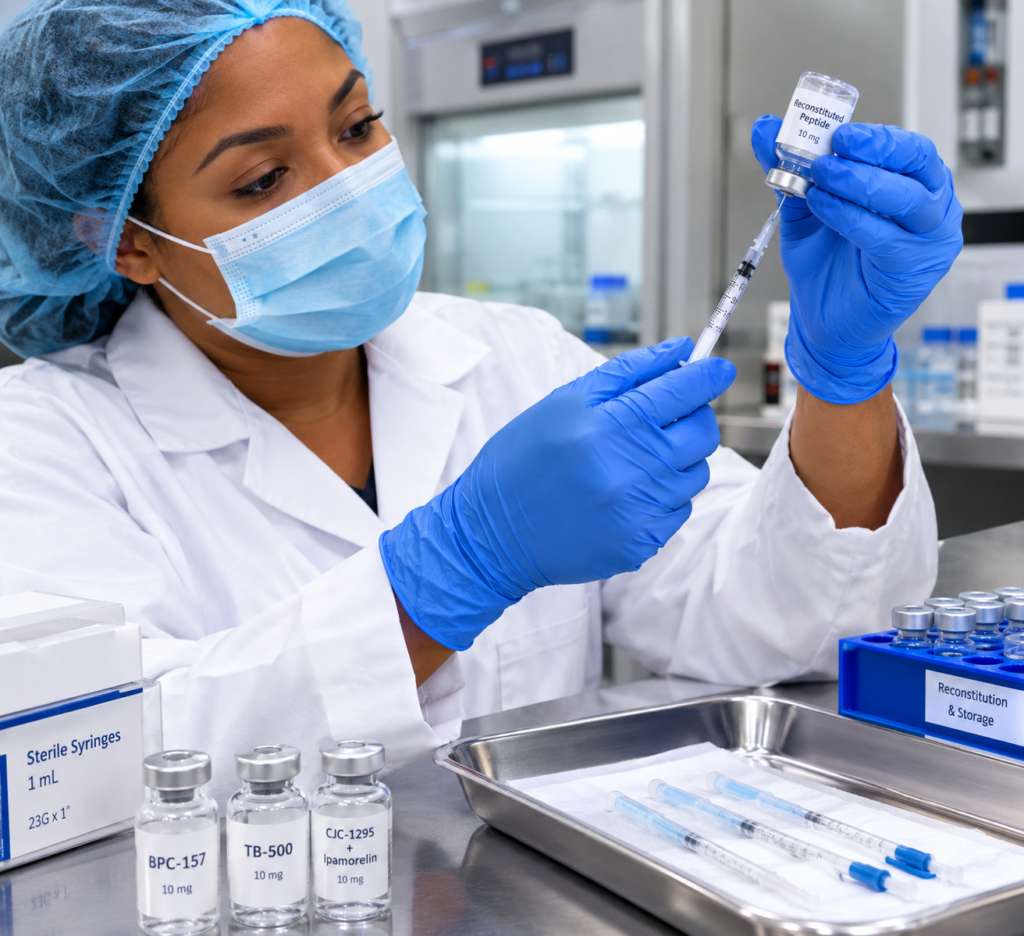
Oct
Peptides are precision-synthesized amino acid chains designed to support targeted biological research across metabolic health, cellular repair, and cognitive optimization. When exploring research applications, understanding chemical purity and stability is critical. High-purity synthetic peptides allow researchers and biotechnology professionals to conduct controlled studies on tissue regeneration, hormone pathways, and cellular longevity. Each batch undergoes rigorous testing to guarantee sequence integrity and accurate molecular weight.
To maintain baseline structural integrity, our compounds are supplied as lyophilized powders packaged in vacuum-sealed glass vials. Proper handling requires sterile reconstitution techniques using bacteriostatic water to preserve molecular stability over time. Whether investigating tissue recovery protocols or exploring cognitive health pathways, premium-grade research compounds ensure predictable experimental outcomes. View our verified Certificates of Analysis to review analytical testing data, or explore our full collection of research compounds directly in the Shop.
Can Multiple Peptides Be Reconstituted or Combined in the Same Syringe?
The growing interest in biohacking, longevity research, and performance enhancement has led many researchers, laboratory professionals, and health-optimization enthusiasts to ask practical questions about administration protocols. A frequent query centers on efficiency: can multiple peptides be reconstituted or combined in the same syringe?
While drawing two different research compounds into a single barrel seems like a logical way to minimize administration frequency and skin irritation, peptide chemistry presents complex physical and chemical challenges. Combining two distinct amino acid sequences can trigger molecular degradation, altered solubility, or unexpected cross-reactivity.
To understand why mixing compounds requires careful evaluation, we must first address a foundational question: what are peptides, how do their molecular structures behave in liquid solution, and what guidelines govern their safe handling?
What Are Peptides and How Do They Work?
To understand how synthetic compounds behave when mixed, it helps to review basic peptide biochemistry. Simply put, what are peptides?
Peptides are short chains of amino acids linked together by peptide bonds. They function as signaling molecules in biological systems, directing cells to perform specific functions—such as releasing growth hormone, initiating tissue repair, reducing systemic inflammation, or modulating neurotransmitter activity.
Unlike large, robust proteins that maintain complex tertiary structures, smaller peptides are delicate bio-molecules. Their stability depends heavily on environmental variables including:
- Isoelectric Point (pI): The specific pH level at which a peptide molecule carries no net electrical charge.
- Solubility Limits: The concentration cap at which a peptide remains fully dissolved in liquid solution without precipitating.
- Secondary Structure: The folding patterns (such as alpha-helices or beta-sheets) necessary for proper receptor binding.
Because individual amino acid sequences carry unique electrical charges and hydrophilic or hydrophobic properties, combining two separate chains into one liquid environment can alter their delicate balance.
The Science of Combining Peptides: Key Chemical Factors
When two reconstituted compounds are combined inside a single syringe barrel or storage vial, several biochemical interactions occur simultaneously. Understanding these principles helps researchers prevent compound denaturation.
       [ Peptide A Solution ]                 [ Peptide B Solution ]
  (Specific pH & Charge State)           (Specific pH & Charge State)
                   \                             /
                    \                           /
                     [ Combined Syringe Barrel ]
                                   │
                      Is Molecular Compatibility Met?
                                  ╱ ╲
                                 ╱   ╲
                       YES      ╱     ╲      NO
                               ╱       ╲
                              ▼         ▼
                      [ Stable Mixture ] [ Precipitation / Aggregation ]
1. pH Stability and Buffer Disruption
Reconstituted peptides require a specific pH range to remain fully dissolved and active. Bacteriostatic water (0.9% benzyl alcohol in sterile water) typically has a slightly acidic pH ranging from 4.5 to 7.0.
Certain peptides are synthesized to stay stable in acidic conditions, while others require a neutral or slightly alkaline pH. When you mix two compounds with opposing pH requirements:
- One or both peptides may fall out of solution (precipitation).
- The net charge of the molecules changes, leading to physical aggregation.
- The peptide sequence may undergo rapid chemical hydrolysis, rendering it inactive.
2. Peptide Cross-Reactivity and Aggregation
Cross-reactivity in a solution refers to unwanted non-covalent interactions between different amino acid sequences. When two active sequences are mixed together in high concentrations inside a narrow syringe:
- Hydrophobic regions on adjacent chains may cling together, creating insoluble clumps.
- Positive charges on one peptide may bind to negative charges on another, altering receptor-binding capacity.
- The altered structure can prevent the ligand from binding effectively to target cellular receptors.
Reconstitution Protocols: Step-by-Step Safety Guidelines
Whether you are preparing a beginner peptide guide for muscle recovery or exploring advanced longevity research, maintaining aseptic technique and following a standardized peptide reconstitution guide step by step is essential for protecting compound integrity.
   ┌─────────────────────────────────────────────────────────────┐
   │              STEP-BY-STEP RECONSTITUTION FLOW               │
   └─────────────────────────────────────────────────────────────┘
                                  │
                                  ▼
   ┌─────────────────────────────────────────────────────────────┐
   │ 1. STERILIZE: Wipe vial stoppers with 70% IPA alcohol swabs.│
   └─────────────────────────────────────────────────────────────┘
                                  │
                                  ▼
   ┌─────────────────────────────────────────────────────────────┐
   │ 2. DRAW DILUENT: Pull required volume of BAC water.         │
   └─────────────────────────────────────────────────────────────┘
                                  │
                                  ▼
   ┌─────────────────────────────────────────────────────────────┐
   │ 3. RECONSTITUTE: Direct diluent down the inner glass wall.  │
   └─────────────────────────────────────────────────────────────┘
                                  │
                                  ▼
   ┌─────────────────────────────────────────────────────────────┐
   │ 4. DISSOLVE: Gently swirl glass vial; NEVER shake barrel.   │
   └─────────────────────────────────────────────────────────────┘
                                  │
                                  ▼
   ┌─────────────────────────────────────────────────────────────┐
   │ 5. STORE: Refrigerate immediately at 2°C – 8°C (36°F–46°F). │
   └─────────────────────────────────────────────────────────────┘
Protocol Guidelines
- Sanitize Working Surfaces: Clean all preparation surfaces with isopropyl alcohol. Wipe the rubber stoppers of both the diluent vial and the lyophilized powder vial with fresh alcohol swabs.
- Measure Bacteriostatic Water: Using a sterile syringe, draw the exact calculated volume of bacteriostatic water needed to achieve your desired concentration.
- Smooth Reconstitution Flow: Insert the needle at a 45-degree angle against the glass wall of the powder vial. Slowly release the diluent so it trickles down the glass rather than spraying directly onto the delicate freeze-dried cake.
- Gentle Dissolution: Never shake a reconstituted vial. Gently swirl the vial between your fingers until the powder is completely dissolved into a clear, transparent solution.
- Inspect Clarity: Check the solution under bright light. It must be completely clear without visible floating particles, cloudiness, or discoloration.
Can You Draw Multiple Peptides Into the Same Syringe?
In research environments, the general recommendation for combining reconstituted compounds in a single syringe depends on timing:
Direct Vial-Sharing vs. Syringe-Mixing
- Never Mix Powders in the Same Vial: Reconstituting two different raw freeze-dried powders in the same single vial is strongly discouraged. Long-term storage of mixed liquid peptides drastically increases the rate of chemical degradation, cross-reactivity, and pH instability.
- Immediate Co-Administration (The “Draw & Use” Method): Drawing two pre-dissolved compounds into the same syringe immediately prior to administration is acceptable only if both compounds share compatible pH characteristics and do not exhibit immediate physical precipitation.
Best Practices for Syringe Stacking
If drawing two compatible research solutions into a single syringe:
- Draw Compound A: Pull the precise dosage from Vial A into your sterile syringe.
- Incorporate Air Offset: Draw a tiny bubble of air into the syringe tip to prevent back-flushing Solution A into Vial B.
- Draw Compound B: Carefully insert the needle into Vial B and pull the required dosage.
- Visual Inspection: Verify that the liquid inside the syringe remains completely clear. If cloudiness or swirling precipitation forms instantly, discard the syringe immediately.
- Administer Without Delay: Do not store a pre-loaded syringe containing multiple compounds. Use it immediately to minimize fluid contact time and prevent degradation.
Storage, Shelf Life, and Temperature Stability
Proper storage conditions are critical for preserving amino acid integrity. A frequent operational question among research professionals is: how long do reconstituted peptides last in fridge environments?
| Storage State | Temperature Range | Average Shelf Life | Key Considerations |
| Lyophilized (Unopened) | -20°C to 4°C (-4°F to 39°F) | 12 to 24 Months | Keep away from direct light and moisture exposure. |
| Reconstituted (In Fridge) | 2°C to 8°C (36°F to 46°F) | 28 to 30 Days | Preserve sterility; benzyl alcohol degrades past 30 days. |
| Combined in Syringe | 2°C to 8°C (36°F to 46°F) | Administer Immediately | Do not store combined liquid mixtures; discard if unused within 1 hour. |
Reconstituted research compounds must be kept refrigerated at temperatures between 2°C and 8°C (36°F to 46°F). Avoid storing vials in door shelves where temperature fluctuates every time the unit opens. Protect liquid solutions from direct sunlight and UV rays, as light exposure breaks down peptide bonds over time.
Popular Peptide Categories and Their Compatibility
Different research disciplines explore specific peptide groups for targeted physiological outcomes. Understanding these categories helps clarify why certain research protocols align well while others require separate administration routes.
1. Tissue Repair and Muscle Recovery Protocols
Researchers investigating tissue regeneration often combine secretagogues and tissue repair factors. When reviewing a beginner peptide guide for muscle recovery, researchers typically examine:
- Growth Hormone Releasing Peptides (GHRPs): Such as Ipamorelin or GHRP-6.
- Growth Hormone Releasing Hormones (GHRHs): Such as CJC-1295 (DAC or No DAC).
- Repair & Recovery Factors: Such as BPC-157 and TB-500 (Thymosin Beta-4).
Compatibility Note: Ipamorelin and CJC-1295 No DAC are frequently combined due to their complementary signaling pathways and similar pH stability profiles. Similarly, BPC-157 and TB-500 are widely studied together for synergistic biological research.
2. Focus, Cognition, and Neuro-Research
In neurobiology and cognitive science, researchers study central nervous system signaling using specific best peptide protocols for focus and cognition. Common compounds include:
- Semax & Selank: Nootropic signaling peptides designed to support neuroplasticity, memory retention, and stress modulation.
- Noopept & Dihexa: Synthetics researched for synaptogenesis and cognitive support.
Compatibility Note: Neuropeptides designed for intranasal administration should never be combined in syringes with injectable systemic compounds. Always maintain strict separation between systemic parenteral administration and mucosal protocols.
Summary Checklist: Dos and Don’ts of Mixing Peptides
To maintain laboratory efficiency and sample integrity, follow this simple decision checklist:
- DO inspect all reconstituted solutions for physical clarity, floating particles, and discoloration before mixing.
- DO use fresh alcohol wipes on all vial stoppers before inserting needles.
- DO administer drawn syringe combinations immediately rather than storing pre-filled syringes in the refrigerator.
- DON’T reconstitute two separate lyophilized powders inside the exact same storage vial.
- DON’T shake reconstituted vials; always swirl gently to prevent mechanical shear stress on molecular chains.
- DON’T freeze reconstituted liquid peptides after thawing, as ice crystal formation damages peptide bonds.
Conclusion
Understanding what are peptides and respecting their delicate chemical structures is fundamental to achieving reliable research results. While combining two compatible reconstituted solutions into a single syringe immediately prior to use is a common practice to reduce administration frequency, long-term storage of mixed compounds in vials or syringes should be strictly avoided due to risks of pH imbalance, molecular aggregation, and cross-reactivity.
By adhering to strict aseptic techniques, observing correct refrigeration parameters, and following evidence-based reconstitution protocols, researchers can ensure compound purity, reproducibility, and safety.
To explore verified, high-purity research compounds backed by independent analytical testing, visit the [PEPTIDES GREY MARKET] Shop. For additional details on ordering, shipping timelines, or sample verification, explore our About Us page or review our complete Shipping Policy. Have specific research inquiries? Reach out to our technical support team directly through the Contact Us portal.
